Blueprint AI
UnitedMasters had built distribution rails for independent artists, but planning, pitching, and growth still required a label-style team they couldn't get. Guidance was treated as a product, not a service.
I led design from 0→1: a coach in every artist's pocket. Shipped to 13.7K artists in 10 months, and validated paid conversion before opening monetization broadly.
Distribution wasn't the bottleneck. Guidance was.
UnitedMasters had built distribution rails, but artists needed more than tools…they needed guidance.
- How do I pitch my next release?
- Where should I focus my energy?
- When do I drop, and what do I say?
There was an internal music team with deep knowledge, but no way to scale it. Reps could only help a fraction of our artists. Everyone else was guessing.
See it in action
Three constraints that couldn't be engineered around
This was not a simple automation problem.
- The Assistants API was still in beta, with limited reliability guarantees
- Artist metadata varied widely, from rich histories to sparse profiles
- Midway through development, API costs increased, forcing monetization questions earlier than planned
Scope could have been reduced or templated advice leaned on. Instead, trust and usefulness were prioritized, even if that meant slower progress.
What I led
I led design end-to-end. The hardest calls crossed disciplines:
The interaction model
Onboarding, prompt scaffolding, and the feedback loop that taught artists how to ask better questions.
The monetization model
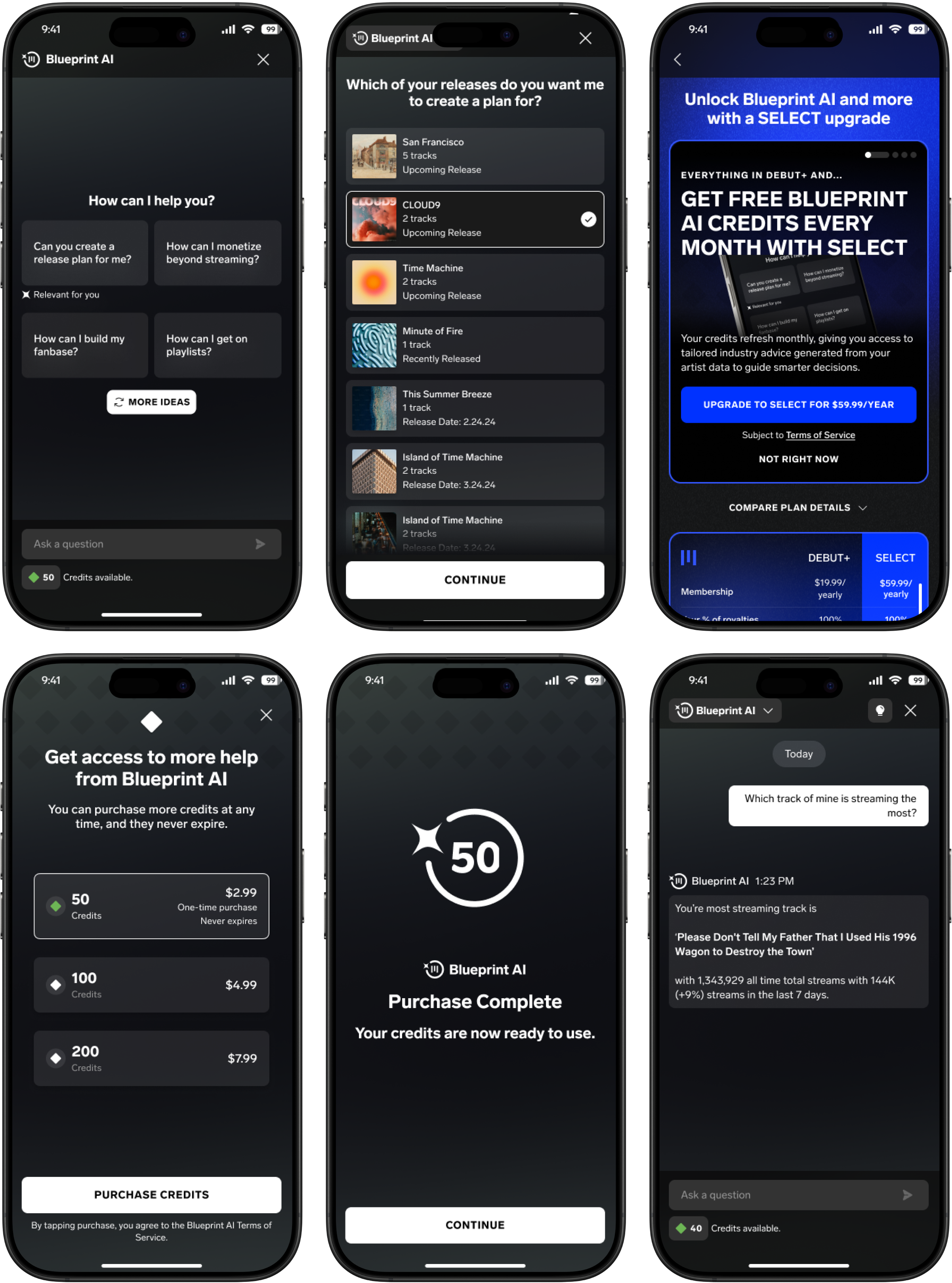
When API costs spiked mid-build, I designed a credit system to keep early usage free at the surface while protecting unit economics underneath.
The prompt grounding
Worked with engineering to wire prompts into real release data, audience signals, and Music Team-sourced questions, so output felt personal even on prompt one.
Even artists with sparse profiles needed to see useful output on prompt one. That constraint shaped almost every design call.
Three calls I'd make again
Prove value before monetizing
Pricing was delayed until repeat usage showed clear intent. There were reasons to monetize earlier, but launching paywalled would have undercut trust before adoption could earn it. The bet paid off in 6K trial starts and 3.7K SELECT subscriptions at GTM.
Anchor advice in real context
Every prompt grounded in the artist's own data: release history, timing signals, audience patterns. Generic GPT advice was a non-starter; an artist with 12 tracks should never get the same playbook as an artist with two.
Set clear boundaries
I designed suggested questions, example prompts, and explicit “here's what I can't help with” surfaces. AI tools fail when users ask the wrong question. Guardrails are a UX problem, not a model problem.
Earned trust in four phases
Blueprint AI was released in phases to validate trust and value before broad exposure.
Phase 0: Internal QA (1st iteration)
Music Team reps reviewed outputs in detail. Their feedback shaped guardrails, fallback logic, and tone.
Phase 1: Targeted pilot
Phase 1 launched with artists who had recently released music. Early prompts focused on release timing and playlist pitching.
"How it works" preview
Phase 2: Partner rollout
Access expanded to SELECT and PARTNER tiers across web, iOS, and Android. Engagement was monitored, and onboarding refined where confusion surfaced.
Artists see smart suggestions based on their upcoming releases, audience data, and real questions sourced from the UnitedMasters Music Team.
Phase 3: Public launch and monetization
Once usage patterns confirmed value, pay as you go credit bundles were introduced. This helped manage costs without blocking early trust.
Purchasing credit bundles
Outcomes
Press
UnitedMasters adds ‘AI career coach’ and real-time royalty payouts
Distributor UnitedMasters has launched two new features: Blueprint AI and Real-Time Royalties. The first is an “AI-powered music career coach” that will offer artists release plans, marketing insights and other tips.
Read article →UnitedMastersUnitedMasters Launches Game-Changing Features for Independent Artists
With Blueprint AI and Real-Time Royalties, artists can finally get personalized assistance without the label backing and get immediate access to their money when they earn it.
Read article →What this taught me about AI in creative tools
Blueprint AI showed that in creative industries, AI's value isn't replacement. It's reach. Done well, it puts a label-style team in every independent artist's pocket. Done well, it earns trust before it earns money.